Bitcoin trust vs. will: which one actually protects your coins
Both are legal structures. Neither one, on its own, moves a single sat — bitcoin only responds to keys, not court paperwork. Here's what each actually does, and what both still need.
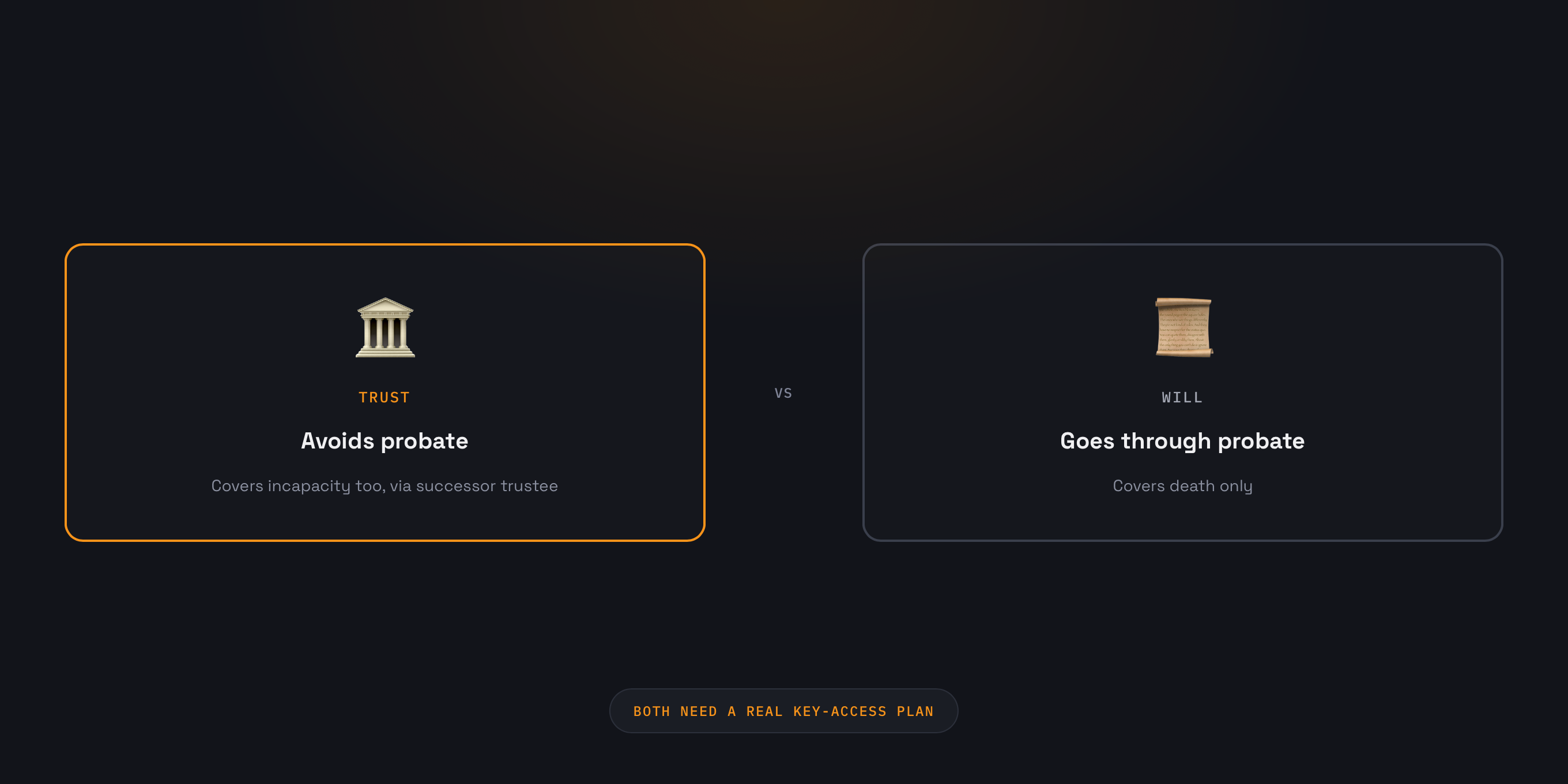
Two legal paths, one shared requirement: real access to the keys. Diagram: Bitcoin Almanack.
What each document actually does
A will names who inherits your assets and goes through probate — a court process that verifies the will, settles debts, and formally transfers ownership, which can take months and becomes a matter of public record. A trust holds assets on behalf of a beneficiary and, once properly funded, transfers them without probate at all: the trustee simply steps into the role the trust document already assigned them, privately and typically faster.
Both are built for a world where every asset has an institution — a bank, a county recorder, a brokerage — that can verify the document and act on it. Bitcoin has none of that. Whether a will or a trust names the beneficiary, the actual transfer of bitcoin depends entirely on whoever can produce a valid private key. Naming an owner on paper and having usable access to the coins are two completely separate problems.
The step people skip: actually "funding" the trust
For a trust to work for any asset, it has to be "funded" — retitled into the trust's name. For a house, that's a deed. For bitcoin, there's no title office, so funding really means: the trustee has to end up with a genuine, tested way to reach the coins. A trust document that says "the Trustee shall hold all bitcoin" without a corresponding multisig key, documented seed-phrase location, or custody-service relationship is legally complete and operationally empty.
A will has the identical gap on the executor side: naming an heir in a will doesn't transfer any technical capability to that heir. See our full bitcoin inheritance planning piece for the mechanics of building that access layer regardless of which legal vehicle you use.
Where a trust pulls ahead: incapacity
A well-drafted trust can name a successor trustee empowered to step in the moment the grantor becomes incapacitated — not just after death. That gives a trust the same functional coverage as pairing a will with a separate power of attorney, in a single document. A will alone only ever activates at death; it has nothing to say about a stroke, a coma, or dementia.
That said, a trust is more expensive to set up and maintain than a will, and for smaller estates the added cost and complexity may not be worth it. As with every bitcoin-specific estate decision, the right answer scales with the size of the holding and how much coordination the family is willing to manage.
BITCOIN ALMANACK ANALYSIS
Trust vs. will, compared
TRUST
WILL
Avoids probate
Yes
No
Covers incapacity
Yes, with successor trustee
No — death only
Setup cost
Higher
Lower
Needs a bitcoin key plan?
Yes, regardless
Yes, regardless
General guidance, not a recommendation for any specific holding · Table: Bitcoin Almanack
WHY IT MATTERS
Estate planning tools were built for a world with institutions to verify against. Bitcoin removes that institution entirely, which means the choice between a trust and a will — usually a straightforward cost-versus-features decision for other assets — comes with an identical, unavoidable requirement either way: a real, tested plan for whoever inherits to actually reach the keys.
What to watch next
1.Estate attorneys building bitcoin-specific trust language. Standard trust templates rarely address key custody; expect more firms to develop bitcoin-aware boilerplate.
2.Custody services expanding trustee-facing products. Collaborative custody firms are increasingly building tools aimed specifically at trustees and executors, not just individual owners.
3.State-level digital asset fiduciary laws. Some states have adopted versions of the Revised Uniform Fiduciary Access to Digital Assets Act; coverage and clarity still vary widely.
Frequently asked questions
Does putting bitcoin in a trust avoid probate?
Yes, that's the trust's main legal benefit — assets titled to the trust bypass court-supervised probate. But avoiding probate is a paperwork question; the trustee still needs a real, separate plan to access the actual bitcoin keys.
Is a will enough for bitcoin?
A will can name who inherits bitcoin, but it goes through probate and only covers death, not incapacity. Like a trust, it accomplishes nothing on its own without a paired technical plan for the executor to actually reach the keys.
Can a trust cover incapacity as well as death?
Yes, if it names a successor trustee who can step in during incapacity, not just after death — something a simple will can't do on its own, since a will only takes effect after death.
SOURCES & DATA
Unchained Capital — bitcoin estate and trust planning ↗
Casa — collaborative custody for trustees and heirs ↗
General education, not legal advice — consult a qualified estate attorney for your jurisdiction and situation. See our editorial process and corrections policy.

Sam Okafor
Security Reporter covering wallets, self-custody, and the tools that keep bitcoin safe.