Reporting bitcoin gifts to the IRS: what givers and recipients actually owe
Receiving bitcoin as a gift isn't a taxable event. Giving a large amount can trigger a filing requirement, even when no tax is actually owed. Here's exactly where the line is.
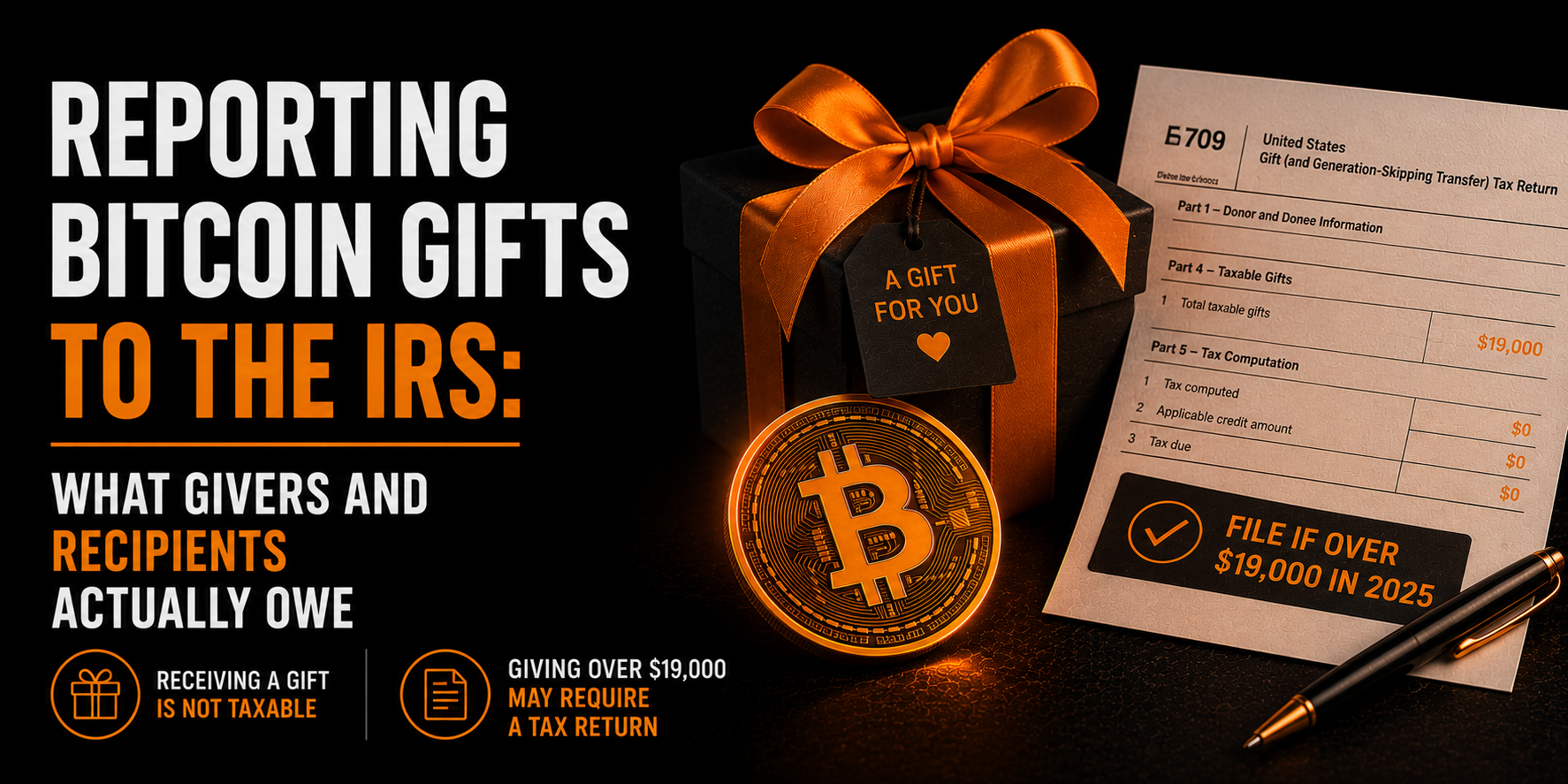
Two people, two very different tax questions — and only one of them usually has to file anything. Diagram: Bitcoin Almanack.
Receiving a gift is not a taxable event
This is the part that surprises people most: under U.S. federal tax law, receiving a gift — bitcoin included — is not income to the recipient, and there's no tax owed at the moment of receipt regardless of how large the gift is. The IRS treats the gift tax as the giver's obligation to track and potentially report, not the recipient's. A recipient's tax exposure only arrives later, whenever they eventually sell the bitcoin, and even then the calculation depends on information they need from the giver, not anything about the gift itself.
What triggers a filing requirement for the giver
The federal gift tax has an annual per-recipient exclusion amount — a threshold below which a gift requires no IRS filing at all, adjusted periodically for inflation. Gifting bitcoin valued above that threshold to any single person in a calendar year requires the giver to file IRS Form 709, the gift tax return. Crucially, filing the form does not usually mean tax is actually due: amounts above the annual exclusion typically count against the giver's much larger lifetime gift and estate tax exemption, and actual gift tax is only owed once that lifetime exemption is fully used. Most people who file Form 709 in a given year owe nothing — they're just tracking against the lifetime number.
Valuing the gift correctly requires using bitcoin's fair market value on the date of the gift, which for a volatile asset means documenting the specific date and a reliable price source — something givers should do at the time, not reconstruct later.
What the recipient actually needs to keep
Because a gift recipient inherits the giver's original cost basis and holding period — a rule called "carryover basis" — the recipient's eventual capital gains calculation depends entirely on information only the giver has: what the giver originally paid, and when the giver originally acquired it. Without that information in writing, a recipient may have no reliable way to calculate their taxable gain when they eventually sell, and defaulting to a zero-cost-basis assumption can mean paying tax on the entire sale value rather than just the actual appreciation.
The practical fix is simple and often skipped: anyone giving bitcoin should hand over a written record — the original purchase date, the original cost basis, and the date and fair market value of the gift itself — alongside the coins.
WHY IT MATTERS
As bitcoin gifting between family members becomes more common — a grandparent stacking sats for a grandchild, a parent seeding a child's first wallet — the paperwork gap is becoming a real problem. The tax rules are straightforward once understood, but they depend on documentation that's easy to skip in the moment and hard to reconstruct years later.
Frequently asked questions
Do I owe tax on bitcoin I received as a gift?
No. Receiving a gift, including bitcoin, is not a taxable event for the recipient under U.S. federal tax law. Tax only becomes relevant later, when the recipient eventually sells, and it's calculated using the giver's original cost basis and holding period, not the value on the date of the gift.
When does a bitcoin gift require filing Form 709?
The giver must file IRS Form 709 if the value of bitcoin given to any one recipient in a calendar year exceeds the annual gift tax exclusion amount, which is indexed for inflation and changes periodically. Filing the form does not necessarily mean tax is owed — it typically counts against the giver's lifetime exemption instead.
What records should someone keep after receiving a bitcoin gift?
The recipient should get the giver's original cost basis (what they paid) and the original acquisition date in writing, since both are required to calculate capital gains correctly whenever the bitcoin is eventually sold.
SOURCES & DATA
Annual exclusion and lifetime exemption amounts change periodically — confirm current figures with a licensed CPA or the IRS directly. General education, not tax advice. See our editorial process and corrections policy.
TERMS IN THIS STORY:
DCA

Rafael Ortiz
CPA covering bitcoin tax, retirement accounts, and estate planning.