X Money runs on Cross River — and not on bitcoin
Cross River Bank will supply the banking rails behind X Money: FDIC-insured interest-bearing accounts, a Visa debit card, and peer-to-peer payments without leaving the app. The announcement made no mention of crypto.
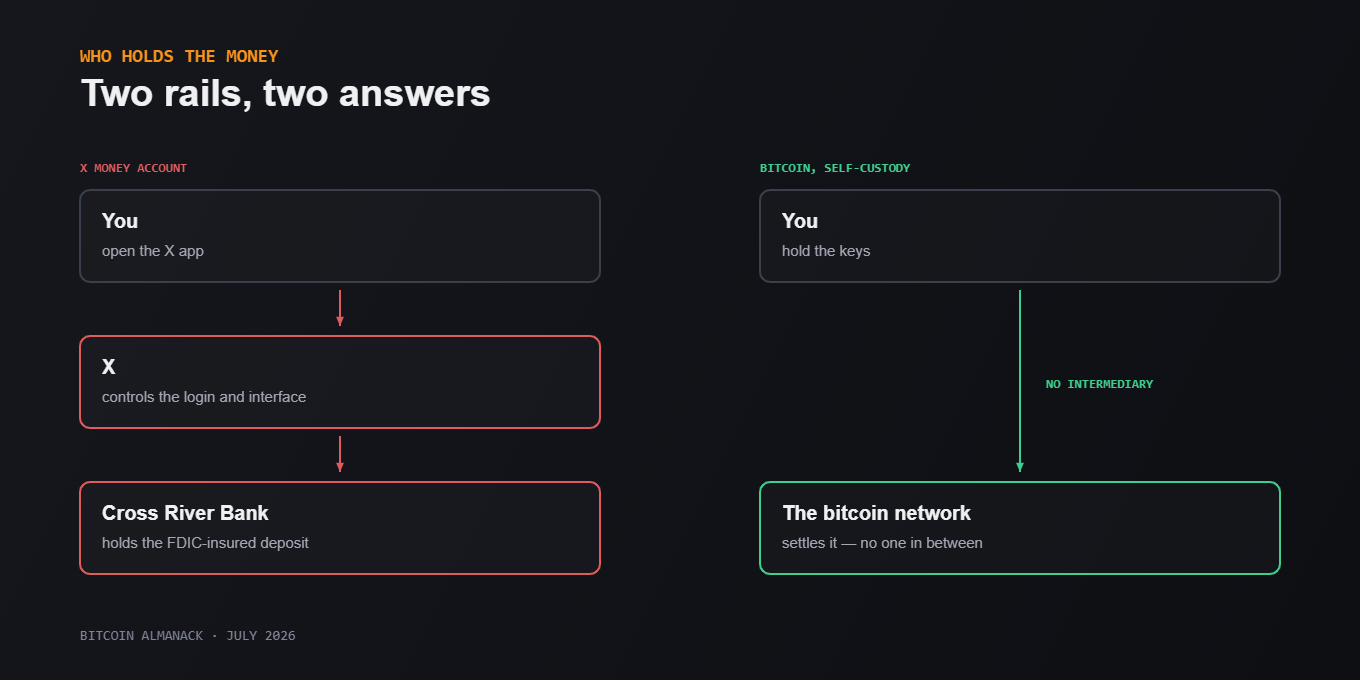
Who holds the money in an X Money account. Diagram: Bitcoin Almanack.
Cross River Bank announced on Monday that it will power X Money, the financial layer built into the X app. The pitch is that X becomes the first US social platform to embed FDIC-insured, interest-bearing accounts, a Visa debit card, and broader payment capabilities directly into the feed — money movement that never asks you to leave the app.
For a publication about bitcoin, the notable thing is what the announcement does not say. There is no mention of cryptocurrency, and none of stablecoins. The "everything app" is launching its money product on a bank charter, dollar deposits, and Visa — the most conventional rails available. That is the story worth sitting with, because Cross River is not a bank that lacks crypto capability: it already provides stablecoin settlement infrastructure to other fintech clients. The plumbing exists. It simply is not what shipped.
The division of labour is the part most coverage skips. Only a chartered bank can hold insured deposits and issue certain payment products under US law, so Cross River supplies the regulated infrastructure and the connections to payment rails, while X builds the interface and brings the users. Money you send or hold moves through Cross River's regulated systems rather than sitting on X's own balance sheet — which is a genuine consumer protection, and also the precise reason an X Money balance is not the same kind of thing as bitcoin in a wallet.
An X Money balance is a claim on a bank, accessed through an account a social platform controls. That gives you real things: federal deposit insurance if the bank fails, reversibility when a payment goes wrong, interest while the money sits. It also gives you a platform between you and your money, on a service where account suspension is not hypothetical. Bitcoin in self-custody inverts every one of those traits — no insurance, no reversals, no counterparty, and no one who can freeze it. Neither design is strictly better; they are answers to different questions, and the useful move is knowing which question you are asking.
What X Money does confirm is the direction of payments generally: financial services collapsing into the apps people already use, supplied invisibly by banks through embedded finance arrangements. Bitcoin's own version of that trend runs through the Lightning Network and products like Fold's gift-card push into TikTok Shop — same instinct, different settlement layer. If X ever adds crypto, the rails announced this week are what it would be bolted onto.
Two things are worth watching rather than assuming. Cross River and X disclosed no financial terms, no transaction volumes, and no specific rollout timeline beyond the announcement, so claims about scale are speculation for now. And some outlets report a nationwide launch to US Premium subscribers with a headline savings rate, alongside an unresolved 2023 FDIC enforcement action against Cross River concerning fair-lending oversight of its fintech partners' underwriting models. We are not treating either as established until better sourced — but a rate that looks unusually high is always worth asking how it is funded, and a bank operating under heightened partnership oversight is a reasonable thing to know about the institution holding your deposits.
BITCOIN ALMANACK ANALYSIS
Two ways to hold money on your phone
X MONEY ACCOUNT
BITCOIN, SELF-CUSTODY
What you hold
A claim on Cross River Bank
The asset itself, via keys
If the holder fails
FDIC-insured deposits
No insurance, no holder
Can it be frozen?
Yes — bank or platform
No
Payment reversals
Yes — chargebacks apply
No — final on confirmation
Earns interest
Yes, set by the programme
No — it is not a deposit
Comparison of product design, not a recommendation · Chart: Bitcoin Almanack
WHY IT MATTERS
The largest consumer payments launch of the year runs on a bank charter and Visa, not on crypto rails — a useful correction to the assumption that fintech convergence inevitably arrives at bitcoin. What it does prove is the demand side: hundreds of millions of people want money to live inside the app they already have. Whether that money settles at a bank or on a public network is the open question, and this week it settled at a bank.
What to watch next
1.Whether crypto shows up later. Cross River already settles stablecoins for other clients. Adding an asset to existing rails is a product decision, not an engineering one — so silence now is not a permanent no.
2.How the interest is funded. Any headline savings rate has to come from somewhere. Deposit rates that outrun the market are usually promotional, tiered, or subsidised — read the programme terms before moving savings.
3.Account-suspension policy. The novel risk of banking inside a social platform is that platform moderation and account access now touch the same login. How X separates the two matters more than the rate.
Frequently asked questions
Is X Money FDIC insured?
The deposit accounts are, because Cross River Bank holds the deposits and Cross River is FDIC-insured. That insurance protects you if the bank fails. It does not protect you against losing access to your X account, and it is not insurance against the value of anything you hold.
Does X Money support bitcoin or stablecoins?
No. The announcement describes FDIC-insured interest-bearing accounts, a Visa debit card and peer-to-peer payments, with no mention of cryptocurrency or stablecoin support. Cross River does provide stablecoin settlement to other fintech clients, so the capability exists at the bank — it just is not part of what was announced.
What is Cross River Bank's role in X Money?
Cross River is the chartered bank behind the product. Only a bank can hold insured deposits and issue payment cards, so Cross River supplies the regulated infrastructure and payment rails while X builds and operates the app people actually see.
How is an X Money balance different from holding bitcoin?
An X Money balance is a claim on a bank, reachable through an account X controls. Bitcoin in self-custody is an asset you hold directly, with keys nobody can freeze. The first is insured and reversible; the second is neither. They solve different problems — see our self-custody guide.
SOURCES & DATA
Cross River Bank — "Cross River Powers X Money" newsroom announcement (Jul 27, 2026) ↗
Business Wire — full press release text ↗
Finovate — "Cross River to Power Elon Musk's X Money" ↗
The Paypers — analysis of the bank/platform division of labour ↗
Reports of a nationwide launch, a specific savings rate, and an outstanding FDIC enforcement action are single-sourced at the time of writing and are described here as reported, not as established fact. We will update this story as they are confirmed. See our editorial process and corrections policy.

Priya Raman
Payments & Adoption Reporter. Covers where bitcoin actually gets spent — merchant rails, Lightning, and the fintech products competing with it.
MORE FROM THIS WEEK
Bitcoin fails to flip the weekly open, and the retest sends it to $63.7K
TECHNICAL ANALYSIS
Can Wall Street push the Senate to pass the CLARITY Act?
POLICY
Bitcoin lands on TikTok Shop: Fold's gift card puts BTC next to the phone cases
ADOPTION
Lightning quietly compounds: capacity holds near record as payments shift off-chain
TECHNOLOGY